She lets me set up Star Wars fight scenes on our Christmas tree, and not just on the back where no one can see.
Wednesday, December 7, 2011
Sunday, September 4, 2011
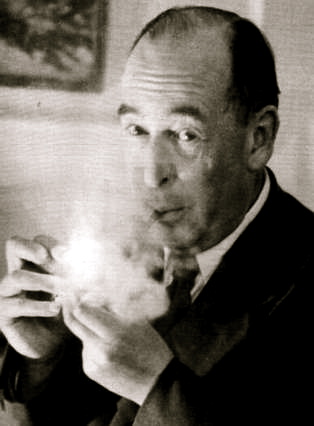
C. S. Lewis on C. S. Lewis
"I was a younger son, and we lost my mother when I was a child. That meant very long days alone when my father was at work and my brother at boarding school. Alone in a big house full of books. I suppose that fixed a literary bent. I drew a lot, but soon began to write more. My first stories were mostly about mice (influence of Beatrix Potter), but mice usually in armor killing gigantic cats (influence of fairy stories). That is, I wrote the books I should have liked to read if only I could have gotten them. That's always been my reason for writing. People won't write the books I want, so I have to do it myself: no rot about 'self-expression.' I loathed school. Being an infantry soldier in the last war would have been nicer if one had known one was going to survive. I was wounded--by an English shell. (Hence the greetings of an aunt who said, with obvious relief, 'Oh, so that's why you were wounded in the back!') I gave up Christianity at about fourteen. Came back to it when going on for thirty. An almost purely philosophical conversion. I didn't want to. I'm not the religious type. I want to be let alone, to feel I'm my own master: but since the facts seemed to be the opposite I had to give in. My happiest hours are spent with three or four old friends in old clothes tramping together and putting up in small pubs--or else sitting up till the small hours in someone's college rooms talking nonsense, poetry, theology, metaphysics over beer, tea, and pipes. There's no sound I like better than adult male laughter."
(A brief autobiographical sketch composed for his American publisher, 1944)
Saturday, September 3, 2011
The Tobolowsky Files: A Beginner's Guide
One of the great discoveries of the summer for me has been The Tobolowsky Files, a (roughly) bi-weekly podcast of "stories about life, love, and the entertainment industry as told by character actor Stephen Tobolowsky." I can say with equal certainty that you probably don't know that name, and you probably know this face:
His credits include Groundhog Day (as insurance salesman Ned Ryerson), Memento (as the cautionary character Sammy Jankis), and Mississippi Burning (as KKK head Clayton Townley). You've seen him in something. In addition (and more relevantly to this post), he's one of the best storytellers I've ever heard. His stories are moving, well-written, and occasionally hilarious, and they're (perhaps more importantly) conscious reflections on the human experience: youth, heartbreak, success, regret, marriage, parenthood, aging, hoping. I think they're wonderful. For the even mildly intrigued, here are some of my favorites:
Episode 4: "The Alchemist" - Stephen explores his most vivid memories of his mother and wonders why those memories, and not others, stuck.
Episode 22: "The Dangerous Animals Club" - Young Stephen and a neighbor boy try to catch every potentially lethal animal in Texas.
Episodes 26-28: "Dark Matter," "Three Honeymoons," and "The Afflictions of Love" - For those ready for a greater commitment, a trilogy of stories about Stephen's marriage to Ann.
Episode 34: "A Good Day at Auschwitz" - An elderly man at Stephen's synagogue is a survivor of Germany's invasion of Poland and, later, multiple death camps.
Episode 39: "Contagion" - Conspiracy and racism on the set of Mississippi Burning.
Thursday, September 1, 2011
Deep greens and blues are the colors I choose.
If you were to contend in my presence that James Taylor has written some hokey songs, you'd get no protest from me. But if you were to further argue that he's never written anything awesome (and for some reason you were unpersuaded by "Fire and Rain," whose only defect that I can discern is its overfamiliarity), I think this is the song to which I'd force you to listen. It's got all the elements of good music: acoustic guitar, a catchy chorus, and a cowboy.
Thursday, August 11, 2011
Therapeutic Fiction
Tim Keller:
"The only time I ever faced death personally was when I had thyroid cancer. From the beginning the doctors told me it was treatable. Still, when I was going under anesthesia for the surgery, I wondered what would happen. You may be curious about what passage from the Bible came to my mind. True confession: What I thought of was a passage from Lord of the Rings. It comes near the end of the third book, when evil and darkness seem overwhelming. Here is what Tolkien tells us about the thoughts of Sam, one of the heroes:
Sam saw a white star twinkle for a while. The beauty of it smote his heart, as he looked up out of the forsaken land, and hope returned to him. For like a shaft, the thought pierced him that in the end the Shadow was only a small and passing thing: there was light and high beauty forever beyond its reach. His song in the Tower had been defiance rather than hope; for then he was thinking of himself. Now, for a moment, his own fate...ceased to trouble him.... [P]utting away all fear, he cast himself into a deep, untroubled sleep.
I remember thinking at that moment: It's really true. Because of Jesus's death evil is a passing thing--a shadow. There is light and high beauty forever beyond its reach because evil fell into the heart of Jesus. The only darkness that could have destroyed us forever fell into his heart. It didn't matter what happened in my surgery--it was going to be all right. And it is going to be all right."
(King's Cross, pp. 210-1)
Tuesday, August 9, 2011
The Rest at the End of Ourselves
Today I've listened repeatedly to what has to be one of the most beautiful recordings I've ever heard: Mindy Smith and Sola's cover of Antje Duvekot's "Reasonland." (Before you start to feel impressed that I know such obscure singer-songwriters, let me say that I heard this song on a mix CD from Marc Tantillo. Most of my musical "finds" roll downhill from him and Josh Glidden.) If you haven't heard it, the link will take you to a free listen on Grooveshark. Art is always preferable to analysis of art, so if you have to choose between listening to the song or reading this post, listen to the song.
Here are the lyrics for the interested:
In Reasonland the emperor came down
The song depicts three people at the end of themselves. The emperor has money enough to sew jewels into his clothing, but he can't buy joy. The king has military might enough to defeat all comers, but he can't coerce beauty. The preacher's wife has a reputation of piety, but she has no assurance of God's love. They have wealth, power, and religion, but at the end of themselves, all they really want is rest. In fact, they want a kind of death, a death to their bankrupt existence and a true surrender to the will of another. They're looking for rescue. They've come to the chasm where forward progress stops and only voice can travel. They pray.
Like these pilgrims, we all have to come to the end of ourselves sooner or later. What we really long for can't be bought or forced or faked. We all live east of Eden, and a sword separates us from the home of rest. All our life is striving: we strive after security, we strive after beauty, we strive after an assurance of God's love. And sooner or later, we too must kneel down by the waves and confess that we've come as far as we can, and we can't go as far as we must. We've come up short, and the distance between our ability and our longing must be made up for in grace. Rest must come as a gift, or not at all.
This is a terrifying turn of events for foreigners to the gospel, but for Christians this is the place of provision. In God's kingdom the blessing comes not to the strong and rich, but to the poor in spirit, to the seaside beggars. Grace comes to the humble. We can come to the end of ourselves without fear, because we know that the rest we long for comes not through our striving but through the grace of Christ, who took our burden so we could have his treasure. Jesus meets us at the shore and offers freely joy, beauty, and love that this world can neither offer nor plunder. The pilgrims' prayers are not in vain. For every Christian there is a laying down at the end of our labor. There's a rest at the end of ourselves.
Here are the lyrics for the interested:
In Reasonland the emperor came down
To the water's edge and said, "I don't know where I'm bound
I've got emeralds and rubies sewn into my gown
But I am sadder than the diamonds in my crown
So will you lay me down in a fiddler's cloud
Lay me down to dream
Let my aching head be still, let me surrender to your will
Lay me down and deliver me"
The mighty king came down to the sea
Said, "I may win any battle that I please
I got a hundred-man batallion, they all fall down at my feet
But there’s a songbird who will not sing for me
So will you lay me down in a fiddler's cloud
Lay me down to dream
Let my aching head be still, let me surrender to your will
Lay me down and deliver me
I wanna fly out to your center
I wanna sink down into your gold
I wanna go down without my dagger
I wanna shed these clothes"
The preacher's wife kneeled down by the waves
Said, "For your love and salvation I have prayed
I am a tired tightrope dancer, I wanna go no more this way
Just give me something, a penny for my faith
So will you lay me down in a fiddler's cloud
Lay me down to dream
Let my aching head be still, let me surrender to your will
Lay me down and deliver me
Will you lay me down, won't you lay me down
Lay me down to dream
Let my aching head be still, let me surrender to your will
Lay me down and deliver me"
The song depicts three people at the end of themselves. The emperor has money enough to sew jewels into his clothing, but he can't buy joy. The king has military might enough to defeat all comers, but he can't coerce beauty. The preacher's wife has a reputation of piety, but she has no assurance of God's love. They have wealth, power, and religion, but at the end of themselves, all they really want is rest. In fact, they want a kind of death, a death to their bankrupt existence and a true surrender to the will of another. They're looking for rescue. They've come to the chasm where forward progress stops and only voice can travel. They pray.
Like these pilgrims, we all have to come to the end of ourselves sooner or later. What we really long for can't be bought or forced or faked. We all live east of Eden, and a sword separates us from the home of rest. All our life is striving: we strive after security, we strive after beauty, we strive after an assurance of God's love. And sooner or later, we too must kneel down by the waves and confess that we've come as far as we can, and we can't go as far as we must. We've come up short, and the distance between our ability and our longing must be made up for in grace. Rest must come as a gift, or not at all.
This is a terrifying turn of events for foreigners to the gospel, but for Christians this is the place of provision. In God's kingdom the blessing comes not to the strong and rich, but to the poor in spirit, to the seaside beggars. Grace comes to the humble. We can come to the end of ourselves without fear, because we know that the rest we long for comes not through our striving but through the grace of Christ, who took our burden so we could have his treasure. Jesus meets us at the shore and offers freely joy, beauty, and love that this world can neither offer nor plunder. The pilgrims' prayers are not in vain. For every Christian there is a laying down at the end of our labor. There's a rest at the end of ourselves.
Friday, July 15, 2011
I can relate to this.
"All of my life I've held onto this fear
These thistles and vines ensnare and entwine what flowers appear
It's the fear that I'll fall one too many times
It's the fear that His love is no better than mine
But just as I am, just as I was
Just as I will be, He loves me, he does
He showed me the day that He shed his own blood
He loves me, oh, he loves me, He does!"
-Andrew Peterson, "Just As I Am"
These thistles and vines ensnare and entwine what flowers appear
It's the fear that I'll fall one too many times
It's the fear that His love is no better than mine
But just as I am, just as I was
Just as I will be, He loves me, he does
He showed me the day that He shed his own blood
He loves me, oh, he loves me, He does!"
-Andrew Peterson, "Just As I Am"
Friday, June 17, 2011
The Gaslight Anthem makes me want to play air guitar.
Air drums, too. At the same time. Fun for me, but not so fun for my wife trying to get me to focus on helping her cook.
That guy in the aviators is a hoot.
Thursday, June 16, 2011
A Fearful Thing
"And therefore this is the very point at which so many draw back--I would have done so myself if I could--and proceed no further with Christianity. An 'impersonal God'--well and good. A subjective God of beauty, truth, and goodness, inside our own heads--better still. A formless life-force surging through us, a vast power which we can tap--best of all. But God Himself, alive, pulling at the end of the cord, perhaps approaching at an infinite speed, the hunter, king, and husband--that is quite another matter. There comes a moment when the children who have been playing at burglars hush suddenly: was that a real footstep in the hall? There comes a moment when people who have been dabbling in religion ('Man's search for God!') suddenly draw back. Supposing we really found him? We never meant it to come to that! Worse still, supposing He had found us?"
-C. S. Lewis, Miracles
Tuesday, June 7, 2011
You Become What You Worship
"For although they knew God, they did not honor him as God or give thanks to him, but they became futile in their thinking, and their foolish hearts were darkened. Claiming to be wise, they became fools, and exchanged the glory of the immortal God for images resembling mortal man and birds and animals and reptiles." -Romans 1:21-23
The Bible tells us that we were made in the image of God, that we were set in the Garden as God's icons, as his idols even, making visible his unseen care and rule and joy. We were made to behold and reflect God's beauty, mirrors to his face, moons to his sun. But we're dumb ("fools" is the technical term), so we stopped doing that and started looking at other things, looking to them to save and satisfy us. And the image began to seep away. Our minds, made to consider and ponder and form new ways to worship, became futile in their thinking. The lights went off inside. We're solar-powered; as soon as we duck in the shade, our systems shut down. We're cut off from the Source. The writer of Psalm 115 nails this: "Those who make [idols] become like them; so do all who trust in them." Those who worship dead things become like them: unseeing, unhearing, unfeeling. Unliving.
If that doesn't make you a little squeamish, you probably haven't reckoned with the fact that money can be an idol. Marriage. Beauty. Power. Possessions. Popular opinion.
Worshiping idols undoes us, tears at our fibers. But gloriously, God's made a way out. A true worshiper, the True Worshiper, came into the world to rescue us out of the hole we were digging. He loved God with all his heart (the only one who ever did), but on the cross he became our idolatry so that we could become his worship of God. He beckoned us back into the light, clothed in his record of righteous praise. And now, as the Holy Spirit shows us the beauty of Christ in that very good news, "we...are being transformed into the same image from one degree of glory to another" (2 Cor 3:18). Jesus turns back the clock on our disfiguration, and as we worship Christ, we become like him.
You become what you worship. Choose wisely.
Thursday, November 25, 2010
A Thanksgiving Conflation
"Bless the LORD, O my soul,
and forget not all his benefits,
who forgives all your iniquity,
who heals all your diseases,
who redeems your life from the pit,
who crowns you with steadfast love and mercy,
who satisfies you with good
so that your youth is renewed like the eagle's."
(Psalm 103:2-5)
"What shall I render to the LORD
for all his benefits to me?...
I will offer to you the sacrifice of thanksgiving
and call on the name of the LORD."
(Psalm 116:12, 17)
"The one who offers thanksgiving as his sacrifice glorifies me."
(Psalm 50:23)
The Psalmist's response to all of God's goodness to him, to God's salvation and care and hearing of prayer, is to offer the sacrifice of thanksgiving. My ESV Study Bible notes tell me that this sacrifice of thanksgiving was one of the peace offerings (Lev 7:11-18) God established for his people to create a rhythm of remembrance, a routine of returning thanks to God for all his undeserved gifts. The peace offerings, of which the thanks offering was one, were different from sin and guilt offerings in one important way: the peace offerings were eaten by the offerer. The sin and guilt offerings, at least the portions that weren't burned up, could only be eaten by the priests; they were holy to the Lord. But when the thanksgiving sacrifice was offered, the meat was enjoyed by the offerer, his family, and the needy. As a reminder that God didn't need the offering, as if he was hungry, he returned it to the people. It was, I'm told, a meal enjoyed together in the presence of God, its Provider and Host. The grateful family sat around the Lord's table and received each course as though it had been passed by the invisible hand of their divine benefactor.
Today, as we ourselves gather around tables spread with the bounty of a good God who sends rain and sun on those who don't deserve it, don't let "Thanksgiving" lose its vertical direction. Make room at your table for One more. No matter who rose early this morning and spend hours up to her elbows in turkey, God is the Host of all our meals. He, as he did with the Israelites, invites us to eat in his presence, to bask in his provision, and to return to him a sacrifice of thanksgiving. In light of all his benefits, and supremely his salvation in Christ, how can we do any less?
Sunday, November 14, 2010
A Selective History of Provision
When Adam needed food, God had already made some.
When Adam needed a wife, God gave him Eve.
When Abraham needed a son, God gave him Isaac.
When Jacob (that rascal!) was on the run, God gave him flocks and a family.
When there was a famine in the Promised Land, God gave his people a home in Egypt.
When Egypt enslaved them, God set them free.
When they were hungry and thirsty, God gave manna, quail, and water from the rock.
When the people needed a king, God gave them David.
When the people were in exile, God brought them home.
When everyone needed a savior, God gave us Jesus.
When Brett doubted that God was going to take care of his family, that was dumb.
Wednesday, November 10, 2010
When a chapter begins this way, I already know I'm in trouble.
"Of course the preacher is above all others distinguished as a man of prayer. He prays as an ordinary Christian, else he were a hypocrite. He prays more than ordinary Christians, else he were disqualified for the office which he has undertaken....Over all his other relationships the pre-eminence of the pastor's responsibility casts a halo, and if true to his Master, he becomes distinguished for his prayerfulness in them all."
-C.H. Spurgeon, Lectures to My Students, ch. 3: "The Preacher's Private Prayer"
Cue conviction.
Monday, October 25, 2010
Thanks for your honesty.
(This is true of me. You, too.)
"My life looks good I do confess
You can ask anyone
Just don’t ask my real good friends
‘Cause they will lie to you
Or worse they’ll tell the truth
‘Cause there are things you would not believe
That travel into my mind
I swear I try and capture them
But I always set them free
It seems bad things comfort me
[Chorus]
Good Lord I am crooked deep down
Everyone is crooked deep down
Good Lord I am crooked deep down
Everyone is crooked deep down
Everyone is crooked deep down"
-Derek Webb, "Crooked Deep Down"
Good thing there's this.
Monday, October 18, 2010
Two Potent Implications of Ephesians 5:22-33 for Husbands
1. A good marriage is a return to the bliss of Eden, a kind of heaven on earth.
2. Like any other kind of heaven, nobody makes it there without somebody getting crucified.
Saturday, July 17, 2010
Weighed Down?
I like what it says about God that this is what makes Jesus really mad:
"[The scribes and the Pharisees] tie up heavy burdens, hard to bear, and lay them on people's shoulders, but they themselves are not willing to move them with their finger." -Matthew 23:4
If your view of God is that he likes to tie up heavy burdens and lay them on your shoulders, hear rather the voice of Jesus:
"Come to me, all who labor and are heavy laden, and I will give you rest." -Matthew 11:28
Wednesday, July 14, 2010
The Devil's Favorite Day
"Tomorrow is the devil's day, but today is God's. Satan cares not how spiritual your intentions may be, and how holy your resolutions, so long as they are fixed for tomorrow."
-J.C. Ryle, Thoughts for Young Men
38 Days from the Minefields
This is probably redundant, since everyone who reads this blog also reads Justin Taylor's...
But let me say publicly, as if there was any doubt, that I'm in love with this song.
[Kim, apparently the prerequisite for becoming an adorable elderly couple is dance lessons, so we better get those on the calendar...in 2030. Also, as long as I'm addressing you parenthetically and publicly, you should know that in the course of writing this blog post, I forgot that I had pasta on the stove and left it there way too long. Welcome to the minefield.]
Sunday, July 4, 2010
Friday, July 2, 2010
This is more important than I like to pretend.
"For by [Jesus] all things were created...all things were created through him and for him."
-Colossians 1:16
Subscribe to:
Posts (Atom)