Showing posts with label dead guys. Show all posts

Sunday, September 4, 2011

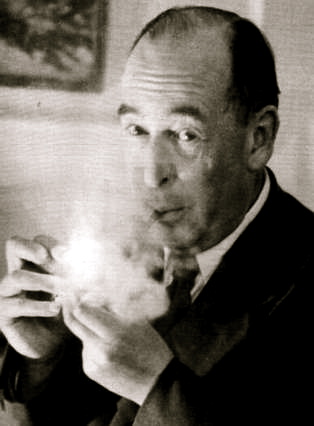
C. S. Lewis on C. S. Lewis


"I was a younger son, and we lost my mother when I was a child.  That meant very long days alone when my father was at work and my brother at boarding school.  Alone in a big house full of books.  I suppose that fixed a literary bent.  I drew a lot, but soon began to write more.  My first stories were mostly about mice (influence of Beatrix Potter), but mice usually in armor killing gigantic cats (influence of fairy stories).  That is, I wrote the books I should have liked to read if only I could have gotten them.  That's always been my reason for writing.  People won't write the books I want, so I have to do it myself: no rot about 'self-expression.'  I loathed school. Being an infantry soldier in the last war would have been nicer if one had known one was going to survive.  I was wounded--by an English shell.  (Hence the greetings of an aunt who said, with obvious relief, 'Oh, so that's why you were wounded in the back!')  I gave up Christianity at about fourteen.  Came back to it when going on for thirty.  An almost purely philosophical conversion.  I didn't want to.  I'm not the religious type.  I want to be let alone, to feel I'm my own master: but since the facts seemed to be the opposite I had to give in.  My happiest hours are spent with three or four old friends in old clothes tramping together and putting up in small pubs--or else sitting up till the small hours in someone's college rooms talking nonsense, poetry, theology, metaphysics over beer, tea, and pipes.  There's no sound I like better than adult male laughter."

(A brief autobiographical sketch composed for his American publisher, 1944)

Thursday, August 11, 2011

Therapeutic Fiction

Tim Keller:

"The only time I ever faced death personally was when I had thyroid cancer. From the beginning the doctors told me it was treatable. Still, when I was going under anesthesia for the surgery, I wondered what would happen. You may be curious about what passage from the Bible came to my mind. True confession: What I thought of was a passage from Lord of the Rings. It comes near the end of the third book, when evil and darkness seem overwhelming. Here is what Tolkien tells us about the thoughts of Sam, one of the heroes:
Sam saw a white star twinkle for a while. The beauty of it smote his heart, as he looked up out of the forsaken land, and hope returned to him. For like a shaft, the thought pierced him that in the end the Shadow was only a small and passing thing: there was light and high beauty forever beyond its reach. His song in the Tower had been defiance rather than hope; for then he was thinking of himself. Now, for a moment, his own fate...ceased to trouble him.... [P]utting away all fear, he cast himself into a deep, untroubled sleep.
I remember thinking at that moment: It's really true. Because of Jesus's death evil is a passing thing--a shadow. There is light and high beauty forever beyond its reach because evil fell into the heart of Jesus. The only darkness that could have destroyed us forever fell into his heart. It didn't matter what happened in my surgery--it was going to be all right. And it is going to be all right."

(King's Cross, pp. 210-1)

Thursday, June 16, 2011

A Fearful Thing

"And therefore this is the very point at which so many draw back--I would have done so myself if I could--and proceed no further with Christianity. An 'impersonal God'--well and good. A subjective God of beauty, truth, and goodness, inside our own heads--better still. A formless life-force surging through us, a vast power which we can tap--best of all. But God Himself, alive, pulling at the end of the cord, perhaps approaching at an infinite speed, the hunter, king, and husband--that is quite another matter. There comes a moment when the children who have been playing at burglars hush suddenly: was that a real footstep in the hall? There comes a moment when people who have been dabbling in religion ('Man's search for God!') suddenly draw back. Supposing we really found him? We never meant it to come to that! Worse still, supposing He had found us?"

-C. S. Lewis, Miracles

Wednesday, November 10, 2010

When a chapter begins this way, I already know I'm in trouble.

"Of course the preacher is above all others distinguished as a man of prayer. He prays as an ordinary Christian, else he were a hypocrite. He prays more than ordinary Christians, else he were disqualified for the office which he has undertaken....Over all his other relationships the pre-eminence of the pastor's responsibility casts a halo, and if true to his Master, he becomes distinguished for his prayerfulness in them all."

-C.H. Spurgeon, Lectures to My Students, ch. 3: "The Preacher's Private Prayer"

Cue conviction.

Wednesday, July 14, 2010

The Devil's Favorite Day

"Tomorrow is the devil's day, but today is God's. Satan cares not how spiritual your intentions may be, and how holy your resolutions, so long as they are fixed for tomorrow."

-J.C. Ryle, Thoughts for Young Men

Tuesday, June 15, 2010

Help for Prayers (and Pray-ers)

Come, my soul, thy suit prepare;
Jesus loves to answer prayer;
He himself has bid thee pray,
Therefore will not say thee nay.

Thou art coming to a King;
Large petitions with thee bring;
For his grace and power are such,
None can ever ask too much.

-John Newton, quoted in D. A. Carson, Jesus' Sermon on the Mount

Wednesday, May 19, 2010

A Case for Good Fiction

"It must be more than thirty years ago that I bought - almost unwillingly, for I had looked at the volume on that bookstall and rejected it on a dozen previous occasions - the Everyman edition of Phantastes [by George MacDonald]. A few hours later I knew that I had crossed a great frontier....Nothing was at that time further from my thoughts than Christianity and I therefore had no notion was this difference really was. I was only aware that if this new world was strange, it was also homely and humble; that if this was a dream, it was a dream in which one at least felt strangely vigilant; that the whole book had about it a sort of cool, morning innocence, and also, quite unmistakably, a certain quality of Death, good Death. What it actually did to me was to convert, even to baptise (that was where the Death came in) my imagination....The quality which had enchanted me...turned out to be the quality of the real universe, the divine, magical, terrifying and ecstatic reality in which we all live. I should have been shocked in my 'teens if anyone had told me that what I learned to love in Phantastes was goodness."

-C. S. Lewis, "Introduction to Phantastes"